



Quick answer: Google AI Overviews now appear on roughly half of all searches, and they’re compressing organic click-through rates by 34–65% depending on query type, according to multiple 2026 studies. Cited pages still earn meaningfully more clicks than uncited ones, but the bigger shift is structural: citations no longer require a top-10 ranking, affiliate links are getting bypassed even when the source content is cited, and “winning” a query now means being extractable — answering the question directly, in a format an AI system can lift and quote — not just ranking for it.
I run SEO and content strategy for B2B ecommerce brands — Adobe Commerce and Magento storefronts, BigCommerce builds, ERP-integrated sites. Over the past year, almost every content audit I’ve run has surfaced the same conversation: “Our rankings look fine. Our traffic doesn’t.” That gap is AI Overviews, and it’s the reason this topic deserves more than a surface-level explainer.
What Google AI Overviews Actually Do
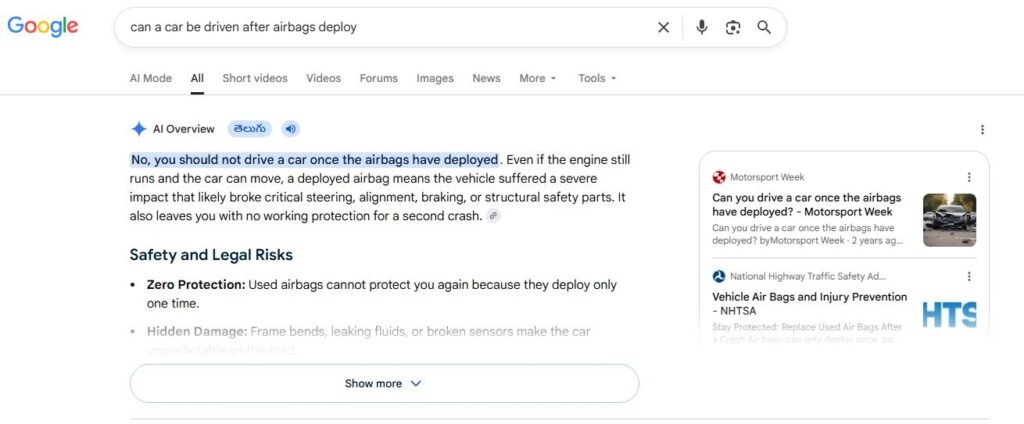
AI Overviews are the AI-generated summary boxes as shown above that now sit above the traditional blue links for a large share of Google searches. Instead of making users click through to compare sources, Google’s Gemini models read multiple pages, synthesize an answer, and present it directly on the results page — with a handful of citations tucked underneath. What used to be a list of ten links competing for attention is now one answer competing with ten links for relevance.
Table of Contents
The mechanics matter for strategy. Google doesn’t need your page to rank #1, or even in the top 10, to cite it. It breaks a query into sub-questions (a process often called “query fan-out”) and pulls the best-matching passage for each one — which means a well-structured page buried on page two can outperform a poorly structured page ranking first.
In the above scenario, the answer is straight, “No, you should not drive a car once the airbags have deployed.”
This means, Google really don’t want their users to read a lengthy article to get this answer, but a quick and short answer does the job.
The Data: What’s Actually Happening to Organic Traffic
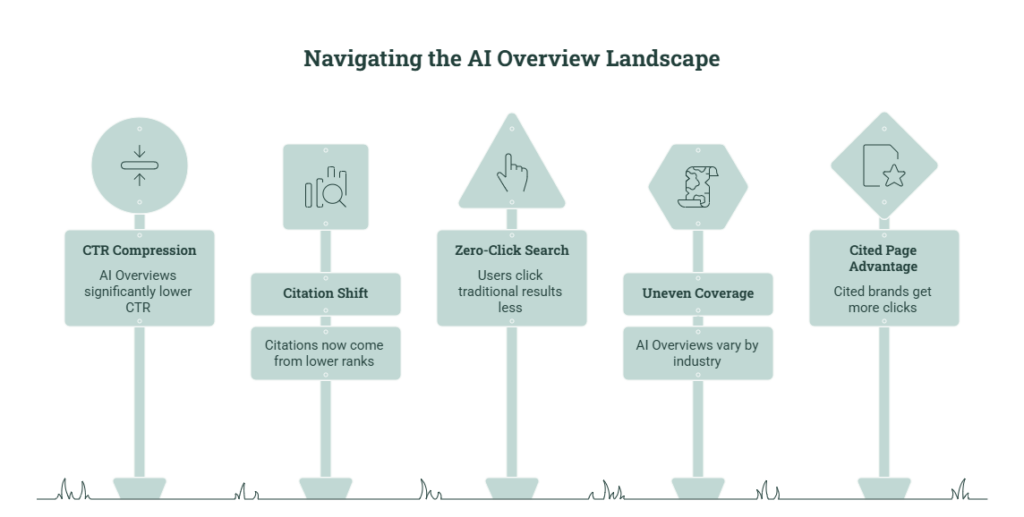
The numbers vary by study and methodology, but the direction is consistent:
- Click-through rate compression. Seer Interactive’s longitudinal study — 53 brands, 5.47 million queries, 2.43 billion impressions tracked from January 2025 to February 2026 — found organic CTR on AI Overview queries fell from 1.76% to as low as 0.61% before partially rebounding to 2.4% by February 2026. Ahrefs’ analysis of hundreds of thousands of keywords found the top-ranking page’s CTR dropped roughly 58% when an AI Overview appeared.
- Citations beat rankings. Ahrefs found only 38% of AI Overview citations now come from pages ranking in the traditional top 10 — down from 76% just a year earlier. A separate GEO benchmark study covering more than 12,500 queries found 83% of citations came from pages outside the top 10 entirely.
- Zero-click is the new baseline. Pew Research found users click a traditional result only 8% of the time when an AI Overview appears, versus 15% without one — and just 1% click a link inside the Overview itself. Overall zero-click search sits above 60% in 2026, up from roughly 50% in 2019.
- It’s uneven across industries. BrightEdge’s 16-month tracking study found AI Overviews now appear on 88% of healthcare queries, 83% of education queries, and 82% of B2B technology queries — while ecommerce coverage actually fell, from around 29% to roughly 4%, as Google appears to route more transactional queries toward Shopping and ads instead.
- Cited pages still win. Across the board, cited brands earn well over double the organic clicks per impression of uncited brands on the same query. Being cited isn’t a consolation prize — it’s the new first page.
Three Shifts Every SEO Strategy Needs to Account For
1. Straight-to-the-point answers are keeping searchers on the results page
This is the pattern I see most often in Search Console data now: impressions climbing, clicks flat or declining, for exactly the informational queries — “what is,” “how does,” “best way to” — that used to be a blog’s bread and butter.
AI Overviews are built to resolve the query in the first few lines. If your content answers the question in paragraph four after two paragraphs of preamble, Google’s model isn’t waiting around for you — it’s pulling the answer from whichever page states it fastest, and the searcher never has a reason to click.
2. Affiliate and citation links are getting routed around your site
This is the one that should worry monetization-driven content teams specifically.
Research from Acceleration Partners’ 2026 AI strategy briefs found that over 95% of AI-generated citations pull from third-party content rather than brand-owned pages, and affiliate-style reviews and comparison content account for 20–40% of that citation share. But being cited and being clicked-through are no longer the same thing.
Analysis from finder.com’s Jon Ostler found that while a large majority of AI citations in product-research queries reference affiliate-style comparison content, only a fraction of the resulting links route through the affiliate’s own tracked link — the rest send the user straight to the provider’s site, skipping the publisher’s monetization entirely.
Google’s AI Overview effectively harvests the expert analysis and discards the business model built to fund it. If your content strategy depends on affiliate revenue, this is no longer a future risk — it’s a current line item.
3. Structure and authority now outrank position
The content types AI Overviews cite most consistently are specific: direct-answer capsules, numbered how-to steps, comparison tables, definition-style explainers, and pages that cite named research or data.
Generic listicles with no proprietary insight — the “10 best X for 2026” template every competitor has a near-identical version of — are getting compressed hardest, because there’s nothing in them an AI system needs your page specifically to say.
What I’ve Learned Auditing B2B Sites for AI Visibility
Most of my audit work involves pulling a site’s Search Console data alongside a page-by-page content review, and one pattern shows up almost every time: templated, boilerplate pages — the kind of ERP-integration or platform-comparison post every competitor in the space has a near-identical version of — are consistently the pages with impressions but no clicks.
That’s not a coincidence. There’s nothing distinctive in that content for an AI system to preserve, so it gets summarized and discarded.
The pages that hold up are the ones built as genuine content clusters: a pillar page with a clear point of view, supported by tightly scoped subpages that each answer one buyer question in depth, cross-linked, and backed by FAQ and schema markup. When I’ve rebuilt content this way — most recently around a platform-migration cluster — the goal isn’t just ranking.
It is giving both Google’s crawlers and its AI systems an unambiguous, quotable answer capsule for every question a buyer might ask along the journey. That’s the difference between content that gets summarized around you and content that gets summarized from you.
How to Get Into AI Search Results: A Practical Framework
Google’s own 2026 guidance is explicit that AI Overview optimization “is still SEO” — it’s not a separate discipline, it’s an additive layer. Here’s what actually moves the needle:
Lead with the direct answer. Every important page should answer its core question in the first 40–60 words, before any preamble. If a human would have to scroll to find your answer, so does the model.
Build topical depth, not just keyword coverage. Because of query fan-out, a single page needs to anticipate and answer the cluster of sub-questions around a topic, not just the exact-match keyword. Cover the “what,” “why,” “how,” and “vs.” angles on one well-organized page or cluster.
Mark up everything. Structured data doesn’t guarantee a citation, but it removes ambiguity for the model. FAQPage, HowTo, and Article schema are baseline; a simple FAQ block looks like this:
{
  "@context": "https://schema.org",
  "@type": "FAQPage",
  "mainEntity": [{
    "@type": "Question",
    "name": "Do AI Overviews reduce website traffic?",
    "acceptedAnswer": {
      "@type": "Answer",
      "text": "Yes, for most informational queries. Studies from Seer Interactive, Ahrefs, and Pew Research all show organic click-through rate declines of 34-65% when an AI Overview appears."
    }
  }]
}
or use Rankmath FAQ snippet.
Prove first-hand expertise, not just information. Original data, named case studies, screenshots, and clearly credentialed authorship are exactly what separates a citable source from a summarizable one — this is E-E-A-T doing double duty for both classic rankings and AI citations.
Diversify beyond your own domain. Reddit and YouTube together account for a large share of all AI Overview citations across industries. A single placement on a high-authority third-party site can out-perform dozens of lower-tier ones — brands have been cited within 60 days of appearing in one strong comparative review on an established domain.
Track AI visibility separately from rankings. Google Search Console now surfaces some AI Overview appearance data. Pair that with manual spot-checks of your priority queries and, where budget allows, a GEO-tracking tool — ranking #3 with zero citations is a different problem than ranking #3 and getting cited every time.
What This Means for Commission Junction, Amazon Associates, and Other Affiliate Networks
If most of your revenue runs through affiliate networks like Commission Junction (now rebranded CJ Affiliate) or Amazon Associates, the AI Overview shift compounds two problems at once.
The first is the citation-without-click pattern covered above. Google’s AI Overview can lift the expert comparison work from your Amazon or CJ-linked review, hand the user a direct answer, and send them straight to the retailer or brand — never through your tracked link, and often never through your site at all.
Amazon Associates has made this worse on its own: reporting from Adweek and eMarketer found Amazon cut commission rates by up to 50% in some categories in early 2026, while its cookie window for crediting a sale remains a tight 24 hours. That’s a shrinking payout stacked on an already-shrinking pool of clicks.
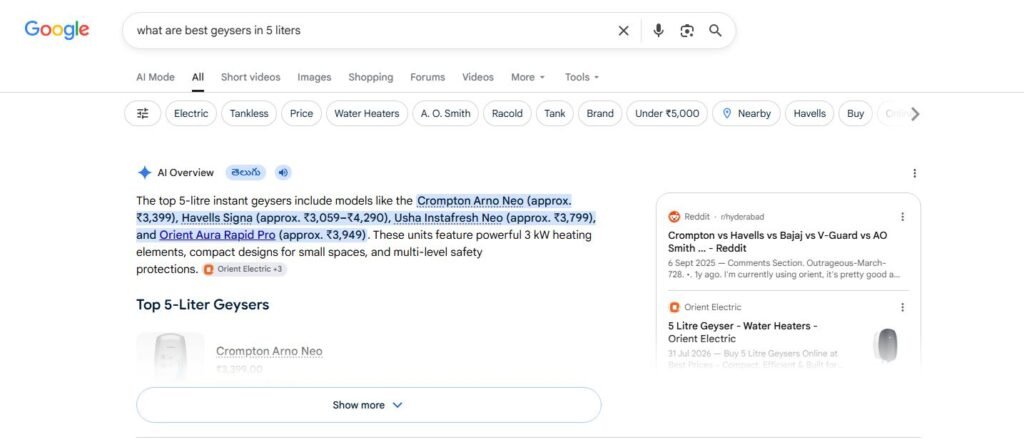
In the above scenario, for the query “What are best geysers in 5 liters”, few review blogs should be there in the SERP but AEO is capturing the show and taking them directly to the Orient electric official website.
The second problem is structural, and it’s coming from the networks themselves. CJ — the network most affiliates still know as Commission Junction — has started building “agentic commerce” infrastructure: embedded checkout technology that lets AI chatbots and shopping agents complete a purchase directly inside their own interface, with no redirect to the merchant’s site at all.
CJ has also rolled out a managed generative-engine-optimization service to help advertisers track and improve how often they’re mentioned inside ChatGPT, Gemini, Perplexity, and Copilot responses. Read between the lines: even the affiliate networks are betting that “click a link, land on a page, buy” is being replaced by “the AI recommends, the AI checks out.”
For affiliates and publishers, the practical response is the GEO discipline covered above, applied with more urgency. Build content Amazon and CJ’s own AI tools can’t easily replicate — original testing, first-party photography, named expertise — rather than templated roundups.
Diversify income across networks and direct brand deals instead of leaning on one program’s cookie window. And start tracking citation share on ChatGPT and Perplexity alongside Google: shopping-related queries on conversational AI tools are already growing faster than any other query category, and consumers are increasingly using them directly for price comparison and deal-finding — the exact jobs affiliate content used to own.
Frequently Asked Questions
Do AI Overviews reduce website traffic?
Yes, for most informational and how-to queries. Multiple 2026 studies put the organic click-through rate decline between 34% and 65% when an AI Overview appears, though the impact varies significantly by industry and query type.
Can you rank in Google AI Overviews without ranking #1?
Yes. Research shows only about 38% of AI Overview citations now come from pages in the traditional top 10, down sharply from a year earlier. Structure, clarity, and topical authority matter more than raw position.
Do AI Overviews hurt affiliate marketing?
They complicate it. AI Overviews frequently cite affiliate-style comparison and review content for its analysis, but often link users directly to the brand rather than through the affiliate’s tracked link, reducing monetization even when the content is cited.
What content gets cited most in AI Overviews?
Direct-answer capsules, numbered how-to guides, comparison tables, definition-style explainers, and pages that cite named data or original research consistently outperform generic, templated content.
Is GEO different from SEO?
Not fundamentally. Google’s own guidance describes AI Overview optimization as still being SEO. GEO adds structural and citation-focused tactics — direct-answer formatting, schema, topical depth — on top of standard SEO fundamentals rather than replacing them.
How do I check if my site is getting cited in AI Overviews?
Check Google Search Console’s AI Overview appearance data where available, manually search your priority queries to see who’s cited, and consider a dedicated GEO-tracking tool for ongoing monitoring at scale.
Abhiram leads SEO and content strategy for a B2B ecommerce agency specializing in Adobe Commerce/Magento, BigCommerce, Shopify Plus, and ERP-integrated storefronts.
Is Your Website Ready for AI-Powered Search? Find Out Where You Stand — and What to Do Next.
Email abhiram@bhuzz.com to discuss your website and explore the next steps.
